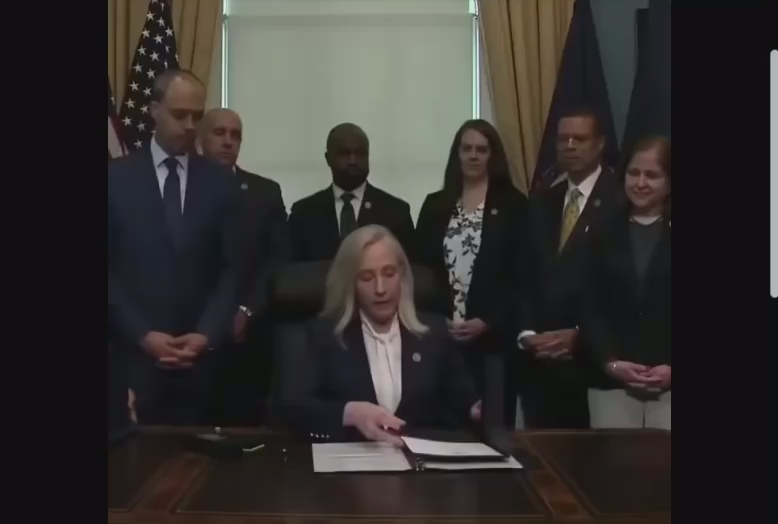
Virginia has a new governor, Abigail Spanberger, and one of her first actions was to rescind former Governor Glenn Youngkin’s executive order that pushed state and local law enforcement to cooperate with ICE.
For Richmond and Central Virginia, that decision matters. Ending forced cooperation reduces the risk that local police departments become extensions of federal immigration enforcement. It matters for families in Southside, for workers commuting through Henrico and Chesterfield, for students, service workers, and long-time residents who already experience disproportionate policing.
But let’s be honest: rescinding an executive order is not the same as protecting people.
Richmond is not a border town. Yet federal immigration enforcement has shown up in workplaces, on streets, and in neighborhoods far from any border. Across the country, ICE agents have conducted operations that look like ordinary policing—traffic stops, street detentions, and warrantless seizures—despite lacking general police powers.
When that happens in Central Virginia, it does not magically become lawful because a federal agency is involved.
ICE’s authority is limited. It is not a roving police force. When agents detain people without proper warrants, establish checkpoint-style operations, or use force outside their legal scope, those actions violate state law. Federal badges do not cancel Virginia law, and federal agents are not immune when they step outside their authority.
This is where Richmond-area leadership must be named.
Governors swear oaths not to “avoid cooperation,” but to protect residents. That obligation applies just as much to people in Richmond, Henrico, Chesterfield, and Hanover as it does anywhere else in the Commonwealth.
Ending cooperation tells local departments, “Don’t assist.”
Protection means saying, “This will not happen here.”
Virginia has a State Police force headquartered in this region. Virginia has Commonwealth’s Attorneys with jurisdiction over crimes committed inside city and county lines. If unlawful policing occurs in Richmond or Central Virginia—by anyone—state leaders have the authority to respond.
Choosing not to act is still a decision.
For years, officials have relied on the convenient fiction that federal agents operate beyond state accountability. That fiction collapses the moment federal agents violate state law. When that happens, they are no longer acting as lawful officers; they are individuals subject to the same laws as everyone else.
Richmond knows what over-policing looks like. It knows what selective enforcement looks like. It knows what happens when officials ask residents to trust systems that refuse to protect them in practice.
Rescinding an executive order is a start.
It is not a shield.
If Virginia’s leadership is unwilling to use state authority to protect Richmond-area residents from unlawful policing, then the oath they swore is hollow. And hollow oaths do nothing for people trying to live, work, and raise families in this city.
This is why RVA Soul calls this moment what it is: a test of leadership, and a test of oaths.
Richmond deserves more than symbolic distance.
It deserves active protection.